How to Buy An Engagement Ring: Everything You Need to Know
How much should you spend? Can you buy an engagement ring on a budget? Is it okay to propose *without* a ring? Our guide answers all your pressing questions
We have included third party products to help you navigate and enjoy life’s biggest moments. Purchases made through links on this page may earn us a commission.
Deciding that you want to propose to someone is one of the most exciting things you can experience. Once you've made up your mind, it's time to figure out how to buy an engagement ring.
Whether you're after a guide on how to buy an engagement ring on a budget, looking to shop for one online, or you're just after a general guide to engagement rings in the UK, you've come to the right place.
When it comes to important purchases, buying an engagement ring is pretty high up there. Although incredibly exciting, there is a lot of responsibility and plenty to consider. Combine that with the stress of planning how to actually propose and we wouldn’t blame you for feeling a little on the nervy side…
Palms starting to sweat? Don’t panic! Feeling confident is key to this process, which is why we’re here with the ultimate guide on how to buy an engagement ring which includes everything from how to find out your partner's ring size to what to look for in a diamond.
Those after an ethical or diamond-alternative engagement ring will also find advice on all the different cuts, shapes, settings and metals you need to know about before you make the big decision.
The Ultimate Guide on How to Buy an Engagement Ring in the UK
Unsplash / Bridget Flohe
As well as answering all of your burning questions about how to buy an engagement ring, we enlisted expert advice from bespoke jewellery designer Emma Clarkson Webb.
Our engagement ring-buying guide leaves no stone unturned and no question unanswered. There's a lot of information to take in, so grab a cuppa, get comfortable and prepare to become an expert in the art of buying a women's or a men's engagement ring.
PS - if you haven't got long, use the links below to skip to the engagement ring section you're after...
While the traditional amount was always thought to be around three months’ salary (thanks to a very effective marketing campaign!), a lot of jewellers are seeing engagement ring spend sit at around a month’s wage. The truth is that you should only spend what feels right for you and what you can afford. What you spend should never exceed what you can afford.
If you're wondering how you can engagement ring on a budget, a good jeweller will be able to suggest options that fit into your price range – be it a more affordable style or stone.
“I try to recommend certain styles or stones that will make the ring more affordable: a halo ring, for example, is a great option for a client wanting something super impactful that won’t be prohibitively expensive, while a chrome tourmaline is a good alternative to an emerald or a tsavorite, for example," says Emma.
What Should I Look For in an Engagement Ring?
Unsplash / Jakob Owens
When buying an engagement ring in the UK, you'll likely need to choose a band metal and the setting, as well as which stone or stones you want. Sound like complete nonsense to you? Fear not, here's everything you should look for in an engagement ring.
Engagement Ring Metals
Choosing the engagement ring metal is important as it will be the main base for your partner's engagement ring. Here are the four main band metals and everything you need to know to make your decision.
Rose Gold Engagement Rings: This dreamy-coloured metal is very up-and-coming in the engagement ring market. If your partner loves anything with a pink hue, and you often see them in rose gold accessories, then a trendy rose gold engagement ring could be the perfect pick.
White Gold Engagement Rings: If it’s a diamond you’re looking for, a white gold engagement ring is one of the most popular choices. It looks super classy and is a mix between yellow gold, silver, palladium and zinc – a real recipe for beauty.
Yellow Gold Engagement Rings: Yellow gold is one of the most traditional ring metals around, and is 75% pure gold. This ring metal is perfect for those who like a classic jewellery look.
Platinum Engagement Rings: The purest metal available, platinum is extremely strong and has a gorgeous white shine to it, so there’s no need for coating. Those who like stunning, clean-cut jewellery that’s guaranteed to stand the test of time will love an engagement ring made from this metal.
Engagement Ring Settings
Thought it was just the metal and stone you needed to think about? Think again. The setting is just as important as the other elements of the ring and really impacts the overall style. The setting of a ring is simply the placement of the stones on the engagement ring. These are the most popular engagement ring settings you'll want to know about:
Cluster Engagement Rings: A cluster ring can contain a large centre stone or a group of stones of equal size, set together in no particular way. The result is a lot of sparkle.
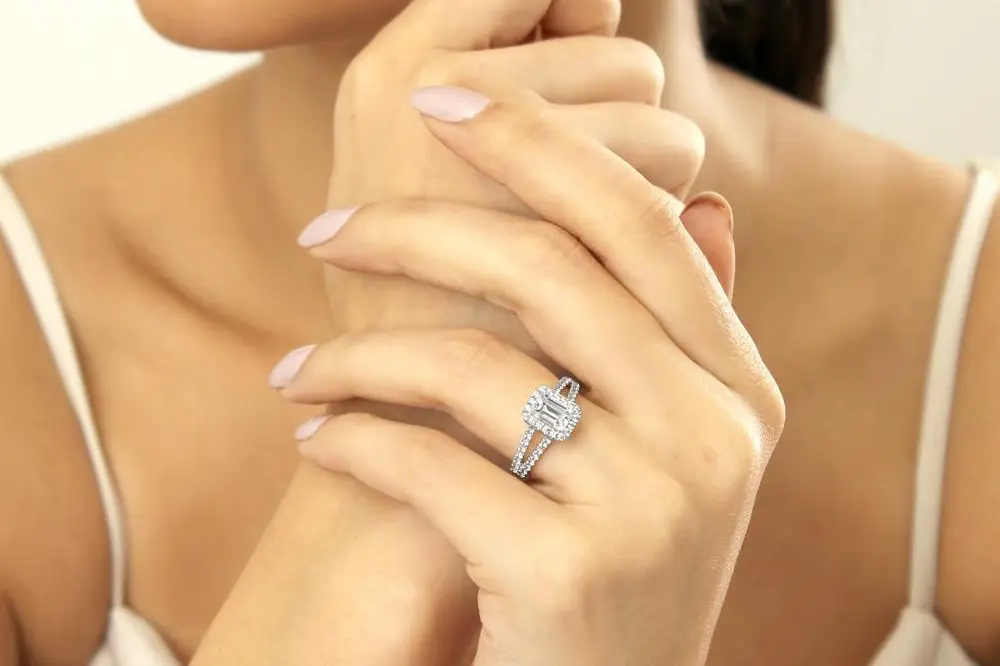
Halo Engagement Rings: If your other half likes serious sparkle, then consider a halo engagement ring. Stones are set around a centre stone and often give the illusion of the stone being larger. This is also a great option if you're looking for an engagement ring on a budget, but want to maximise on the bling.
Solitaire Engagement Rings: For those with a simple, understated style, you can’t go wrong with a classic solitaire. They’re usually set with prongs and give maximum exposure to the diamond. If you're splashing out on a seriously impressive rock, this is the setting to make it the star of the show. No distractions, just simple and elegant.
Pave Engagement Rings: Pronounced pah-vay, this is when the centre diamond is joined by lots of smaller diamonds around the entire band (full pave), or halfway down the band (half pave). It's super pretty and similarly to halo engagement rings, is a great option if you want maximum bling without spending loads on one large-carat stone.
Three Stone Engagement Rings: A three-stone ring is said to signify the couple’s past, present, and future - so cute right!? Usually the central diamond will be either the same size carat or a few carats bigger than the two that sit either side.
How Far in Advance Should I Buy an Engagement Ring?
Unsplash / Katelyn Macmillan
This, of course, depends where you’re buying the ring from. If you’re opting for a bespoke engagement ring, the process can take between four to six weeks to complete.
“This includes everything from the initial consultation, sharing hand-drawn technical sketches before the piece is created by experienced craftsmen in our Hatton Garden workshop,” says Emma.
If you’re buying from a shop or online, take your time. Browse as many as possible and, if you’re buying in a store, make sure you speak to the jeweller to get as much information as you can about their service and rings.
When you find an engagement ring you love, and you're sure it's the one, you can often take it away the same day if it's available at the retailer - but it’s really important not to feel pressured to make a decision on the spot. Walk away, go for a cup of coffee to think it over and take your time.
How Do I Know My Partner's Ring Size?
Unsplash / Kadarius Seegars
Though this isn't crucial, knowing your partner's ring size can be really useful when buying an engagement ring. If you're not sure of their size and don't want to ask, borrow a ring they already have and get it sized at a jewellers.
If you're worried about taking one of their rings out and making them suspicious, you can buy ring size charts online to place their jewellery on top of it. These aren't always 100% accurate but will certainly get you very close to their actual size.
A final option would be to ask a friend or family member to suss this out for you. They could do some trying on with your partner to get a rough size. If you aren't able to do any of the above before you shop for the engagement ring, check with the retailer you buy from that the ring you choose is able to be resized.
Some retailers will offer resizing in their guarantee, so you won't be charged extra.
How Do I Know What Style Ring My Partner Wants?
Look at their existing jewellery: Take mental notes of the jewellery they already wear and what their style is like. These pieces will tell you a lot about the kind of style they might like; from classic and simple to alternative and bold. This will also help you to determine which metal to go for - are they a silver, gold, or rose gold type of person?
Ask their friends and family: We’re willing to bet a lot of money that your other half’s best friend or a close family member will know exactly what sort of ring they'd like based on conversations they've had about different styles. If they don't swear one to secrecy and rope them in to help - they can be your detective and get some ideas for you.
Pay attention to hints: As friends and family members get engaged, watch out for their comments on the rings that are given - the same goes for celebrity engagement rings. It’s a really good way of piecing together your partner's dream ring and style by listening to what they love and don't love about other people's.
Ask them: This is a bit of a rogue suggestion - but if you're really keen to get it right and have absolutely no clue, why not just ask your partner what their dream ring would be? You could phrase it as a bit of a joke, and they may start wondering, but if it means getting the ring spot on, just go for it!
How Do I Find an Ethical or Eco-Friendly Engagement Ring?
Want an ethical engagement ring that doesn't have a questionable history, or an eco-friendly engagement ring that's kind to the planet as well as to your partner?
It's no secret that there's some controversy around diamonds and how they have been mined and sourced. Not all diamond engagement rings have a controversial history, but it's important to ask these questions when you're buying an engagement ring to ensure your stones are conflict-free. If you're buying a gold engagement ring, you'll also want to check to see if the gold is recycled or Fairtrade.
You can also opt for a different kind of stone that is produced in more ethical ways, such as moissanite. Shops like Flawless Moissanite specialize in these dazzlers, and the gems are lab-grown, so the environmental and ethical issues around mining aren't there.
Sarah Fielding from Flawless Moissanite, explains why their engagement rings are the perfect choice for the modern couple. She says, “A moissanite isn’t a compromise. You get all the sparkle, high quality, and durability of a mined diamond, but for a much more affordable price. Plus, lab-grown gems are much kinder to the environment.
“The eco-friendly option is often more expensive, but with a moissanite engagement ring, it’s the exact opposite. Compared to a natural diamond of the same size, a moissanite can be up to 80% cheaper! They’re growing in popularity due to their superior brilliance, cost-effectiveness and environmental sustainability”
Flawless Moissanite are proud to be an ethical engagement ring brand offering complete traceability on all their gems. They focus on high-quality, luxury, moissanite engagement rings in a wide range of styles – from classic vintage to striking contemporary pieces. They also offer a bespoke design service if you want something unique.
Sarah continues, “We want more people to know that moissanite is a fabulous stone in its own right – a diamond alternative, not a diamond simulant. It’s an extremely rare, natural mineral, first discovered in meteorites, and has a very similar appearance to diamonds.”
Unless you’re an expert, you wouldn’t notice the difference between a diamond and a moissanite as both are colourless, but moissanites actually rank higher than diamonds on the refractive index, meaning they’re even more sparkly and give off a dazzling rainbow glimmer.
They’re also durable enough to last a lifetime and are available in all the same cuts and settings as diamonds - seems like a no-brainer to us!
Can I Propose Without a Ring?
If you are stuck on style and really want to maintain the element of surprise, you can propose without an engagement ring, or with a temporary engagement ring. This is a much cheaper engagement ring which is still equally as gorgeous.
You can also use a spontaneous engagement ring to do the amazing proposal and then find time to shop together for the ‘actual’ engagement ring. This way, your partner can choose their own engagement ring style and will still be able to wear and keep the temporary one.
Tips for Buying an Engagement Ring
Before you head off into the world of engagement ring shopping, we have a few more tips to help you on your way.
Check Your Options for a Swap, Return or Resize
This is something that is always worth asking. The answer won’t always be yes, but it’s worth knowing what your options are. Sometimes they’ll offer you options like reshaping or exchanging for another style which is always good to know. This question could come in handy if, worst case scenario, your other half doesn’t like their engagement ring.
There are very few engagement ring retailers who won’t offer engagement ring resizing, but it is important to check with them before you make the purchase.
Check the Ring's Ethics
If you and your partner are conscious of the ethical conflicts that comes with some jewellery, ask the jeweller where they source the materials. Ethical engagement rings are becoming more and more popular and a lot of jewellers now work alongside charities such as Fairtrade to ensure the diamonds and metals are ethically sourced.
Ensure You Know How to Care for the Ring
Different metals, diamonds and stones come with different needs. Some need more taking care of than others so make sure you ask the jeweller how to clean your engagement ring.
Get Ring Insurance
As with any big purchase, we would always recommend looking into insurance. After all, you’re likely to have paid a lot of money for a very special ring, so making sure you’re covered in case the worst happens will give you peace of mind.
Wedding insurance will usually cover your engagement ring, but as you won't have started wedding planning yet, it's worth getting separate insurance to cover the engagement ring at least until you start planning for the big day.
Check the Guarantee
For example, if you’re buying a white gold engagement ring, because of the coating, it can wear away and yellow after a few years so it’s always handy to know if the shop/company itself will offer that service for you.
Remember: Always check the warranties and returns policies before purchasing anything.
Now, we know that was a lot of information to take in, so we'd recommend bookmarking this page so you can come back if you forget anything or just need some reassurance. While you let everything digest, take a look at our romantic proposal ideas and our ideas for proposing at home if you're after something more intimate.
Wedding planning stressing you out? Say goodbye to stress with these free wedding planning spreadsheets and tools - guaranteed to make wedding planning easier
From *that* speech and looking after the rings to organising the stag do and shopping for suits, the best man has more on his plate than you might realise…